

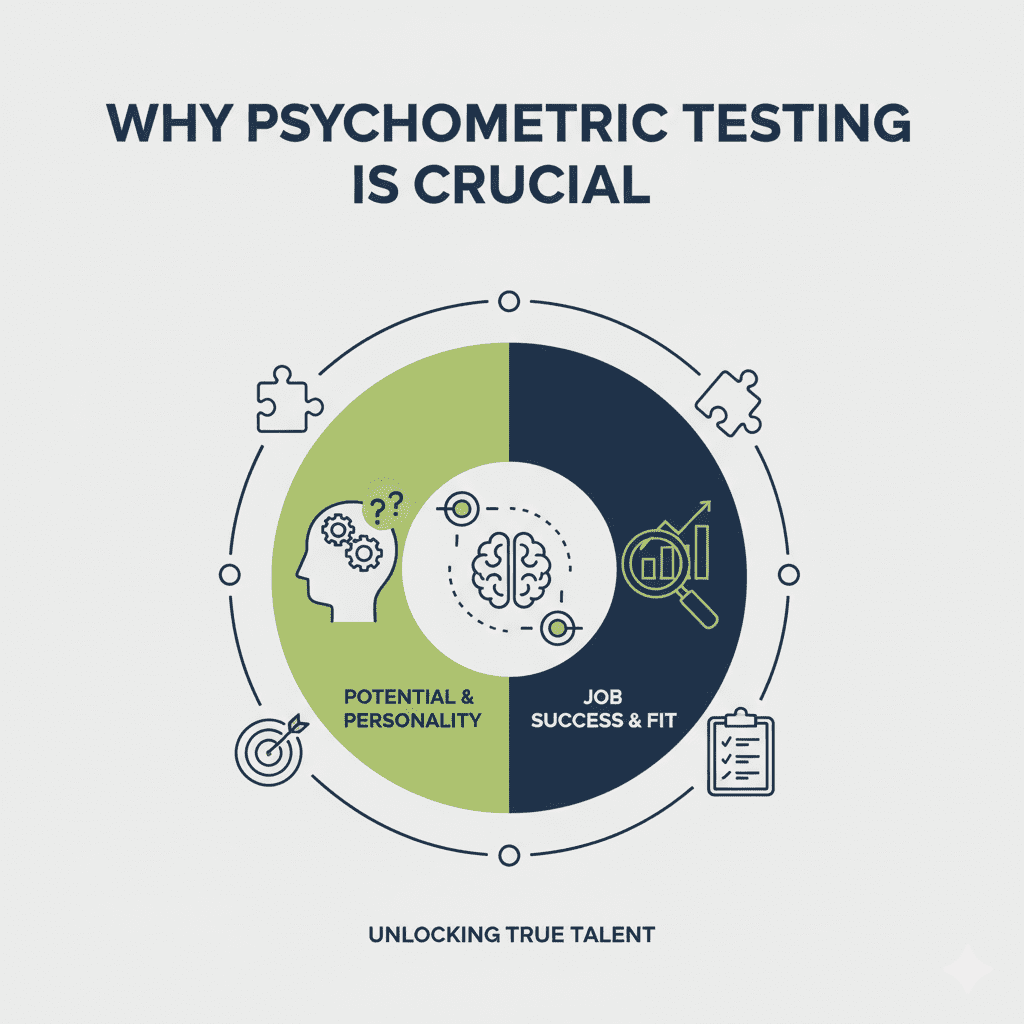
Ever felt that gut-wrenching doubt after a hire? Your candidate aced the interview, their resume was perfect, but a few months in, it’s clear something is off. They might have the skills, but not the drive. Or they clash with the team’s rhythm. That costly mismatch isn’t just bad luck—it’s often a sign that resumes and interviews alone can’t show us the whole person.
This is where psychometric testing comes in. Think of it as a powerful lens, cutting through the polish of an interview to give you a clearer, data-driven picture of a candidate’s mind. It measures the things a resume can’t: their innate problem-solving speed, their natural work style, and how they’re likely to handle real-world job dilemmas.
But here’s the crucial part: it’s not a magic crystal ball. Used poorly, it’s a waste of time and can even be discriminatory. Used strategically, it’s one of the most powerful tools you have to predict job performance, safeguard your culture, and make hires that stick.
This guide will walk you through what these tests really are, why they work, and—more importantly—how to implement them wisely, ethically, and effectively.
Understanding the Core: Definitions, Types, and Purposes
A psychometric test is a standardized assessment designed to objectively measure a candidate’s mental capabilities, behavioral style, and personality traits. Its primary purpose in recruitment is to predict job performance, cultural fit, and long-term potential by providing data points that are difficult to glean from an interview alone.
These tests generally fall into three main categories, each serving a distinct purpose in the evaluation process. The table below outlines their key characteristics and strategic applications.
| Test Type | What It Measures | Common Examples/Sub-Types | Primary Strategic Use in Hiring |
|---|---|---|---|
| Aptitude (Ability) Tests | Innate cognitive capacity and potential to acquire specific skills. | Numerical, Verbal, and Logical Reasoning; Error Checking; Critical Thinking. | Predicting ability to process information, solve problems, and learn quickly. Best for early-stage screening of high-volume roles. |
| Personality Questionnaires | Behavioral preferences, motivations, and typical style of working with others. | Big Five (OCEAN Model), DISC Assessment, Workplace-specific motivation inventories. | Assessing cultural fit, teamwork style, and potential derailers. Used to evaluate alignment with team dynamics and role requirements (e.g., resilience in high-pressure roles). |
| Situational Judgment Tests (SJTs) | Practical judgment and decision-making in realistic work scenarios. | Hypothetical scenarios involving conflict, prioritization, or ethical dilemmas. | Evaluating “soft skills” and practical intelligence. Strong for roles requiring sound judgment, customer service, and leadership potential. |
The Tangible Benefits and Critical Challenges
The strategic adoption of psychometric testing is driven by significant organizational benefits, but it also requires navigating inherent challenges.
Key Advantages
- Improved Hiring Accuracy & Retention: Psychometric tests are among the most powerful predictors of future job performance. Studies cite they can be over 14 times better at predicting performance than the average unstructured interview. By hiring individuals who are a better fit, companies see increased employee retention and engagement.
- Reduced Bias and Increased Objectivity: Standardized tests help level the playing field by assessing all candidates against the same, job-relevant criteria. This reduces unconscious bias that can creep into resume screening or interviews, promoting a fairer process.
- Efficiency and Cost Savings: Automating early-stage screening with aptitude tests can dramatically reduce time-to-hire, especially for graduate or volume recruitment. This saves resources and allows human time to be focused on the most promising candidates.
Essential Considerations and Risks
- Candidate Experience: Poorly communicated or overly long assessments can frustrate top talent and damage your employer brand. It’s crucial to be transparent about the process and respect candidates’ time.
- Risk of Adverse Impact: If a test systematically disadvantages a protected group (e.g., based on gender, ethnicity, age), it can lead to legal challenges. This underscores the non-negotiable need for validated, job-relevant tests.
- Cost and Interpretation: Quality tests from reputable publishers require investment. Furthermore, results require professional interpretation by trained HR staff or psychologists; misinterpreting a personality profile can lead to poor decisions.
- The “Right Tool, Wrong Use” Trap: A major pitfall is using popular assessments for purposes they were not designed for. For example:
- The Myers-Briggs Type Indicator (MBTI) is a valuable team-building tool, but its publishers explicitly caution against using it for hiring, as it measures preference, not ability.
- The DISC assessment is excellent for improving workplace communication but is not validated for selection.
- Clinical tools like the Wechsler Adult Intelligence Scale (WAIS-IV) are administered by psychologists for diagnostic purposes and are inappropriate and risky for general employment screening.
Bridging the Information Gap: Advanced Implementation
Moving beyond basic application requires attention to scientific rigor, legal compliance, and emerging trends.
1. The Non-Negotiables: Validity and Reliability
These two statistical concepts are the bedrock of any legitimate psychometric test.
- Reliability refers to the consistency of the test. Will a candidate get a similar score if they take it again? Key methods to assess this include test-retest reliability and internal consistency.
- Validity is more complex and answers whether the test actually measures what it claims to and predicts relevant outcomes. When selecting a test provider, demand evidence for:
- Content Validity: Do the test questions adequately cover the skill (e.g., numeracy) required for the job?
- Criterion-Related Validity: Most critical for hiring, this shows a proven correlation between test scores and on-the-job performance metrics.
2. Legal, Ethical, and Data Privacy Frontiers
As testing evolves, so does the regulatory landscape. Key considerations include:
- Adverse Impact Analysis: In jurisdictions like the US (under EEOC guidelines) and the UK, you must regularly analyze your testing data to ensure it does not have a discriminatory “disparate impact” on protected groups.
- Data Privacy Compliance: When using advanced or AI-driven tools, strict compliance with data protection laws like the EU’s GDPR is essential. Candidates must be informed about what data is collected, how it’s processed, and their rights.
- Ethical AI and Algorithmic Bias: AI-enhanced assessments promise greater efficiency and reduced human bias. However, they can perpetuate and amplify societal biases if trained on non-representative data. Ethical implementation requires continuous auditing of algorithms for fairness, transparency in how scores are generated, and human oversight.
3. Strategic Integration and Emerging Trends
To maximize value, psychometric data must not exist in a vacuum.
- Holistic Decision-Making: Test results should be one data point among others. Integrate them with structured interview findings, work samples, and reference checks to form a complete picture of the candidate.
- Adopting Emerging Trends: The field is rapidly innovating. Key trends include:
- AI and Machine Learning: Used to analyze complex response patterns, tailor test difficulty in real-time, or even assess verbal responses in video interviews.
- Gamified Assessments: These use game-like exercises to measure cognitive and emotional traits in a more engaging way, often improving the candidate experience.
- Focus on Experience: Leading organizations now design the testing journey to be engaging, transparent, and mobile-friendly, viewing it as an extension of their employer brand.
Putting It Into Practice: A Basic Implementation Roadmap
- Define Job Requirements: Start with a thorough job analysis. What specific cognitive skills and personality traits are critical for success in this role?
- Select Validated Tests: Partner with a reputable provider. Scrutinize their technical manuals for strong evidence of reliability and criterion-related validity for roles similar to yours.
- Map to Your Process: Decide where testing adds most value—early screening or later-stage deep dive? Integrate the platform with your Applicant Tracking System for efficiency.
- Train Your Team: Ensure hiring managers and recruiters are trained to interpret results correctly and avoid biased conclusions.
- Communicate with Candidates: Be transparent. Explain why you use tests, what they measure, and how the data will be used. This builds trust and improves completion rates.
- Review and Iterate: Continuously track the correlation between test scores and new hires’ performance. Use this data to refine your assessment battery over time.
Conclusion: A Tool for Insight, Not a Crystal Ball
Psychometric testing is a powerful lens that brings the often-hidden dimensions of talent into focus—cognitive horsepower, behavioral tendencies, and alignment with workplace culture. However, it is not an infallible oracle. Its true value is realized not in replacing human judgment, but in informing and elevating it with objective data.
The future of assessment lies in the ethical integration of sophisticated technology with timeless psychological principles, all governed by fairness and transparency. By moving beyond a checkbox mentality and embracing psychometric testing as a strategic imperative, organizations can build more capable, cohesive, and resilient workforces.
I hope this detailed guide provides a strong foundation for your article. Would you be interested in a deeper exploration of how to conduct a local validation study for a test in a specific jurisdiction?

About skosanal95@gmail.com
Professional contributor at MN Psychological Consulting, specializing in organizational health and human potential.